
Google launches the Gemini Decisions API and Gemini Decision 1
TL;DR
On November 11, 2026 Google released the Gemini Decisions API and the model gemini-decision-1. One request can score up to 1,000 yes/no, choice, or rubric questions over shared text, image, audio, video, or PDF input. Paid input is $0.10 per 1 million tokens, and the model returns no output tokens.
- Status
- Live
- Released
- Plans
- Gemini API, with a free tier and a paid tier
What changed
Google's November 11, 2026 announcement introduces the Gemini Decisions API, available through the Gemini API in Google AI Studio, with a new model, gemini-decision-1. The Gemini API release notes for the same day record the same release.
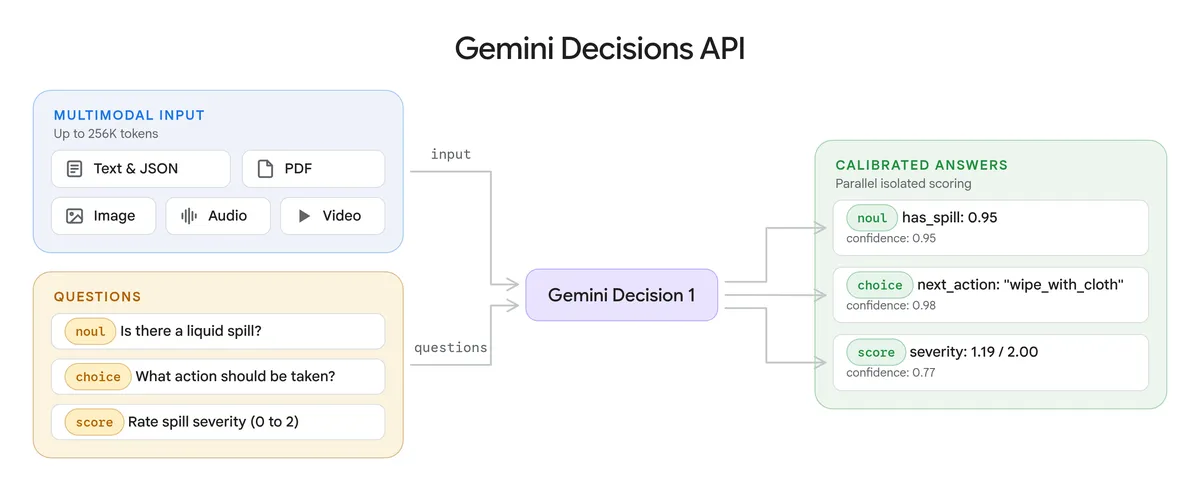
The model page says one request can evaluate up to 1,000 independent questions over shared input of up to 262,144 tokens. The announcement and its diagram describe that input limit as up to 256K tokens. Input can be text, images, audio, video, or PDFs. The model page lists three question types:
- Yes/no, sent as type
noul. It returns a calibrated probability from 0.01 to 0.99 and a confidence score. - Single-select, sent as type
choice. It evaluates 2 to 255 options and returns the top option, a probability for each option, and a confidence score. - Rubric rating, sent as type
score. It evaluates 2 to 255 ordered rubric levels and returns a probability-weighted expected score, a probability for each level, and a confidence score.
The announcement says every answer includes a confidence score from 0 to 1, so code can send an unclear case to a fallback or a person. It also says Google measured 150 to 250 milliseconds end to end, with 50 to 100 milliseconds of model compute for contexts up to 16K tokens, and that latency stayed nearly flat from 1 to 100 questions per request. Those figures are Google's measurements, not a quota.
Pricing on the Gemini API pricing page, for gemini-decision-1: shared input tokens are billed once per request, no matter how many questions you ask. Each question adds tokens for its own instructions, criteria, and formatting. Output tokens are zero, so output price is not applicable. On the free tier, input is free of charge. On the paid tier, input is $0.10 per 1 million tokens. Context caching is not available, and the Batch API is not supported. The pricing table says free-tier requests are used to improve Google's products, and paid-tier requests are not.
The announcement says support is coming soon to Gemini in Google Cloud. It also says ecosystem integrations are rolling out across OpenRouter, LangChain, Vercel, LiteLLM, Pydantic AI, Pipecat, LiveKit, and OpenCode, alongside the google-genai SDKs.
This is a different product from Gemini 4 Carbon, which Google made generally available on November 10 for long agent work.
Why it matters
A team that routes work before an agent writes into Notion can ask a closed question first: which database this belongs in, whether a page is allowed to be updated, or which model should take the next step. The Decisions API is built for that kind of bounded choice. It does not write the Notion page. Gemini 4 Carbon, or whichever model you already call, still does the open-ended work.
The bill is the practical difference. Google prices this model on input only, bills the shared input once, and charges no output tokens. The announcement says that, on Google's shared benchmark suite, this was nearly 5 times cheaper than Gemini 3.5 Flash-Lite called through the Interactions API. Check that against your own prompts before you treat it as your savings.
Use the paid tier if you do not want those requests used to improve Google's products. The pricing table says the free tier is used that way, and the paid tier is not.
Frequently asked questions
How many questions can one request score?
The model page says up to 1,000 independent questions over one shared input. The input limit is 262,144 tokens, which the announcement describes as up to 256K tokens.
What does Gemini Decision 1 cost?
On the paid tier, input is $0.10 per 1 million tokens and output tokens are zero. The free tier does not charge for input. Shared input is billed once per request. Context caching and the Batch API are not available.
Does this model write the answer text?
No. The model page says output is calibrated probabilities for yes/no, choice, and score questions, with zero output tokens. It lists text generation as not supported.
Is Gemini Decision 1 on Google Cloud yet?
The announcement says you can use it now through the Gemini API in Google AI Studio, and that support is coming soon to Gemini in Google Cloud.